
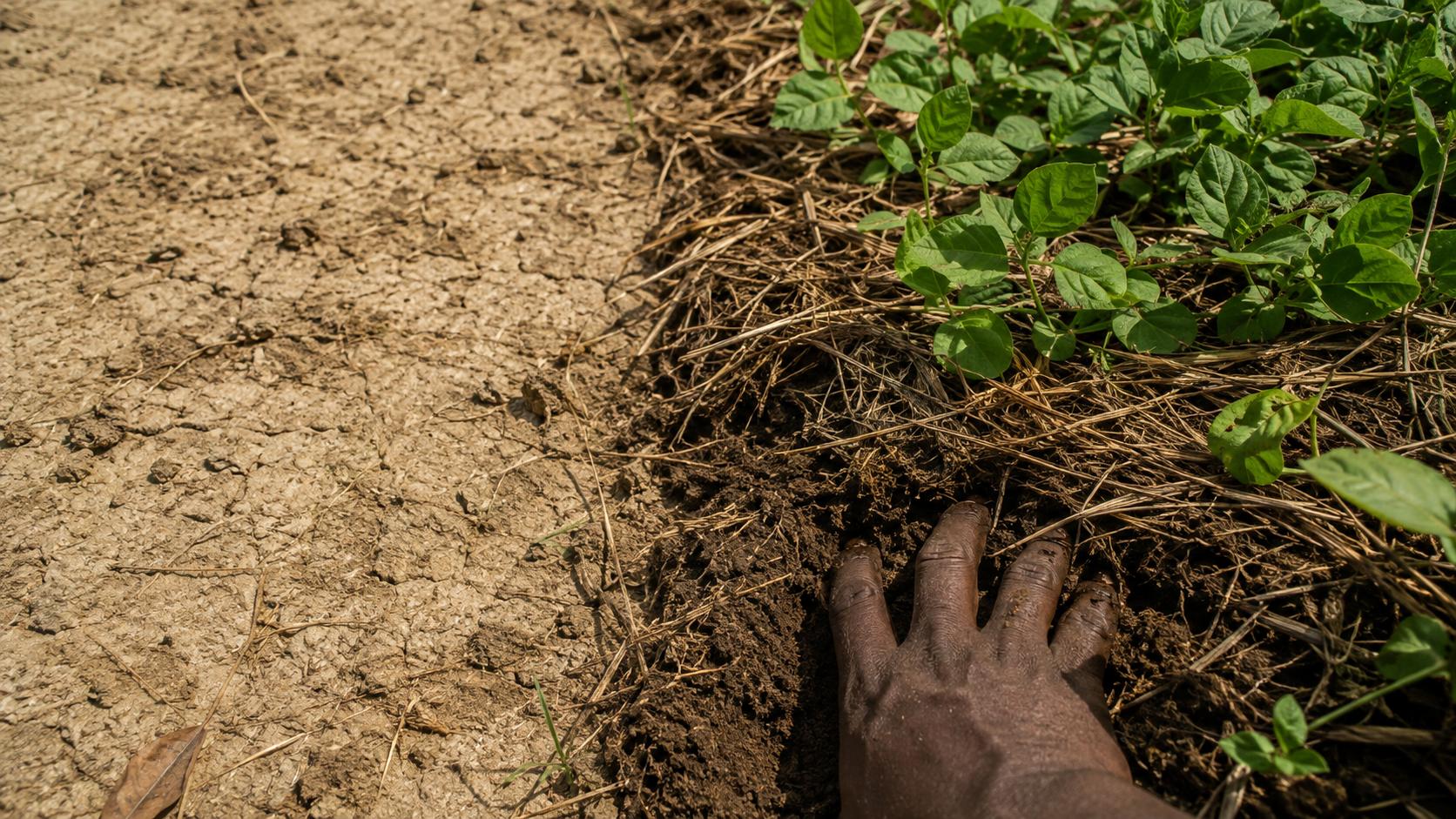
Sandy soil is not bad soil. It is soil that needs help holding on to what it gets. The good news is that help is cheap, practical, and already available on most Nigerian farms.
Musa farms three hectares in Katsina State on light, sandy soil that drains almost as fast as the rain falls on it. Two days after a good rainfall, the ground is dry again. His crops struggle not because he plants badly or waters carelessly but because the soil underneath simply cannot hold what it receives long enough for the roots to use it. He applies fertiliser every season and watches it wash away with the next rain before half of it has done anything useful.
Sandy soil is common across the northern states and parts of south-western Nigeria. It is easy to work, warms up quickly, and drains well enough that waterlogging is never a problem. But those same qualities make it the most difficult soil to farm through a dry spell. It holds almost no water and almost no nutrients on its own. Left unimproved, it forces farmers into a cycle of constant watering and constant fertiliser application just to maintain average yields.
The good news is that sandy soil responds faster to improvement than almost any other soil type. The right inputs change its behaviour noticeably within a single growing season. Here is what to add and how to use it.
Reality Check
Sandy soil loses water fast because its particles are large and loose, leaving wide gaps between them that water drains through quickly. Improving sandy soil means filling those gaps with finer organic material that slows drainage and holds moisture close to the root zone. The soil does not change what it is. It changes how long it can hold what it receives.
Add Organic Matter Every Season Without Exception
The single most important thing you can do for sandy soil is add organic matter regularly and generously. Compost, well-aged manure, or crop residues dug into the top 15 to 20 centimetres of soil fill the wide gaps between sand particles, improve the soil's ability to hold water and nutrients, and feed the soil biology that makes everything else work better.
Apply at least two to four tonnes of compost or aged manure per hectare at the start of every planting season, worked into the soil before planting rather than spread on top. Sandy soil breaks down organic matter faster than heavier soils because it is well aerated, which means the improvement needs to be topped up every season rather than done once and forgotten. Think of it as feeding the soil the same way you feed the crop.
Cover Every Surface That Is Not Growing Something
Bare sandy soil loses moisture from the surface fast, especially during the harmattan. A thick layer of mulch, dry grass, straw, or crop residues spread across the soil surface between and around your crops slows this evaporation dramatically. Aim for a mulch layer of at least five centimetres thick. It keeps the soil cooler, reduces the speed at which water escapes, and as it breaks down it adds more organic matter to the soil underneath.
Farmers who mulch consistently on sandy soil report needing significantly less irrigation to maintain the same crop condition compared to unmulched plots. The water you have lasts longer. The water that falls stays longer. Both of those things reduce cost and reduce risk.
Plant Cover Crops Between Seasons to Build Structure Over Time
Sandy soil that is left bare between planting seasons continues to degrade. Wind strips the lightest particles away and rain compacts the surface into a thin crust that slows water entry the next season. Planting a cover crop of cowpea, lablab, or groundnut immediately after the main crop harvest keeps the soil covered, adds nitrogen through the roots, and when cut and dug in before the next planting, adds another round of organic matter that the following crop will benefit from.
Cover cropping on sandy soil is not just an environmental practice. It is a cost reduction strategy. Every season of cover cropping reduces the amount of fertiliser the next main crop needs to perform well.
Reality Check
Sandy soil will not become deep fertile loam in one season. But with consistent organic matter addition, mulching, and cover cropping, it improves measurably every year. Farmers who have followed this approach on comparable northern Nigerian soils report better water retention, lower input costs, and more stable yields within two to three seasons of consistent practice.
Musa's soil is not the problem. It is the starting point. Sandy soil that is fed, covered, and rested between seasons becomes a more productive asset every year rather than a more exhausted one.
The water is falling on your farm. The question is how long you can make it stay.