
A sick tree rarely announces itself loudly. By the time most farmers notice something is wrong, the problem has been developing for weeks or months. Here is what to look for before it reaches that point.
Emeka walked past the same Gmelina tree every day for two months without stopping. The leaves were slightly smaller than the others. The colour was a little off. He assumed it was just that tree, just its nature, just the way it grew. By the time he stopped to look properly, the bark at the base was soft and the roots were already rotting from a fungal infection that had been spreading underground the entire time. The tree could not be saved. Three neighbouring trees had to be removed to stop the spread.
A sick tree on a Nigerian farm is rarely sick suddenly. It gives signals weeks before the damage becomes serious. Most farmers miss those signals not because they do not care but because they do not know what they are looking for. This guide changes that.
REALITY
CHECK
Most tree diseases and pest infestations are manageable if caught
in the first four to six weeks of showing symptoms. The same problems become
very difficult or impossible to reverse after three to four months. The
difference between a tree that is saved and a tree that is lost is almost
always how quickly the farmer noticed something was wrong.
Walk Your Plantation Once a Week and Know What Normal Looks Like
You cannot spot an abnormal tree if you do not know what a normal one looks like. Before you can diagnose a problem, you need a baseline. Spend time in your plantation when the trees are healthy. Know the colour of the leaves at different seasons. Know how the bark looks and feels. Know how fast the trees in each row are growing relative to each other. A tree that falls behind its neighbours in height or canopy size without an obvious reason is almost always telling you something.
Walk the plantation at least once a week, not just along the edges but through every row. Problems start in the middle of a plantation as often as they start at the edges, and a farmer who only checks the perimeter will miss them until they are already spreading.
The Warning Signs and What They Mean
1. Yellowing or pale leaves outside of dry season
What it looks like: leaves turning yellow or light green when neighbouring trees are still dark green
What it usually means: nutrient deficiency, most commonly nitrogen or iron. First response: apply compost or a balanced fertiliser around the root zone and water in. If the yellowing continues after two weeks, the problem may be root-related.
2. Holes or chewed edges on leaves
What it looks like: irregular holes through the leaf blade, or scalloped edges where something has been feeding
What it usually means: caterpillar or beetle infestation. Check the undersides of leaves for eggs or larvae. For small infestations, remove affected leaves by hand. For larger ones, apply a locally available neem-based spray to the affected trees.
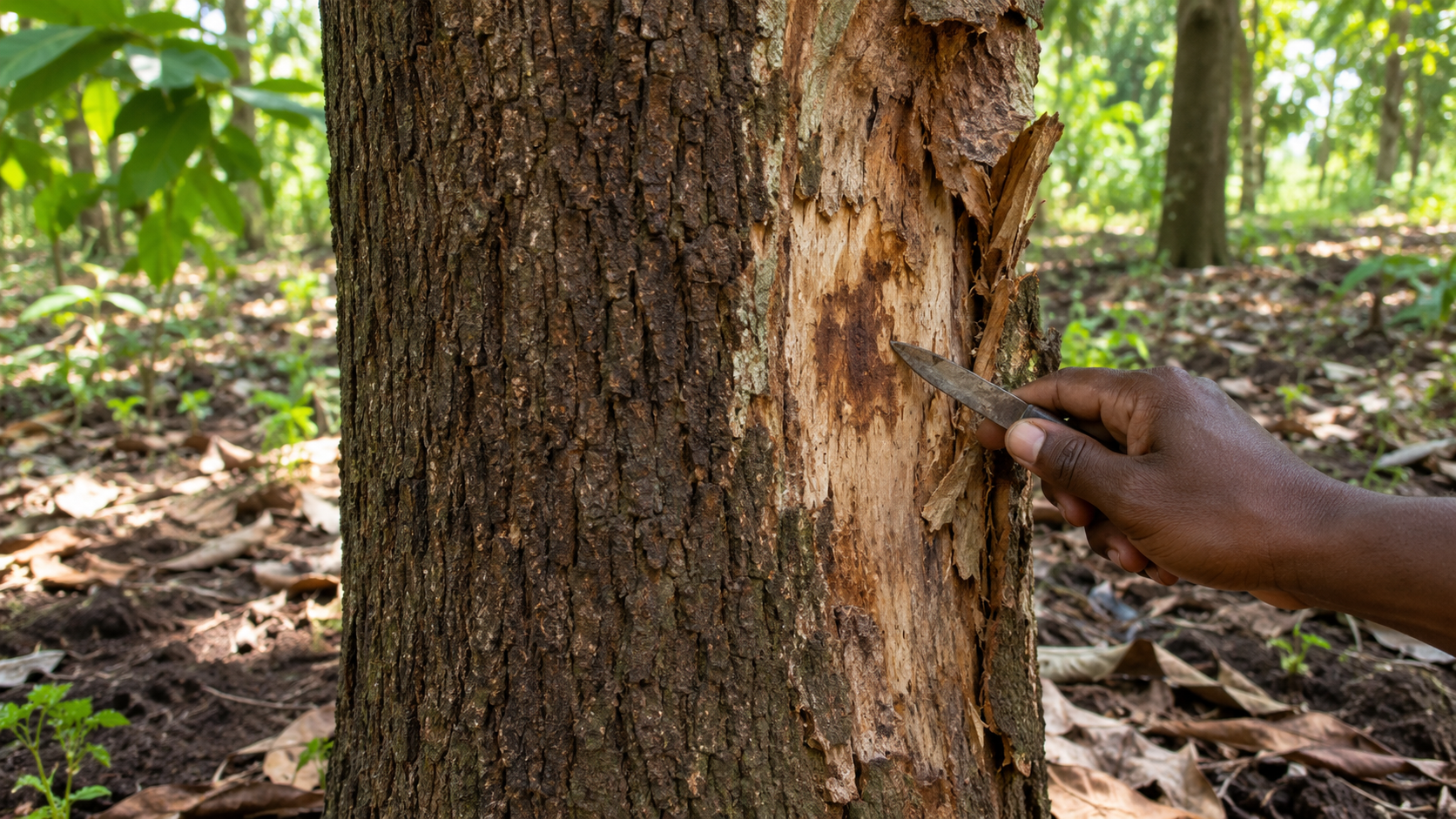
3. Soft, discoloured, or peeling bark
What it looks like: bark that feels soft when pressed, has changed colour to orange, brown, or black, or is lifting away from the trunk
What it usually means: fungal infection or borer damage underneath. Scrape back a small section of the affected bark. If the wood underneath is brown or black rather than white and firm, the infection is already inside the tree. Isolate the tree immediately and do not move cut material to other parts of the plantation.
4. Wilting leaves on one side of the tree only
What it looks like: leaves drooping or dying on one branch or one side while the rest of the tree looks healthy
What it usually means: a blocked water pathway inside the trunk, often caused by a borer or a fungal wilt disease. Cut a small section from an affected branch. If the cross-section shows brown or discoloured tissue rather than clean white wood, the vascular system is compromised. Act quickly as wilt diseases spread fast.
5. White powder or sticky residue on leaves
What it looks like: a white dusty coating on the leaf surface, or a shiny sticky film with small insects clustered underneath
What it usually means: powdery mildew fungus or a scale insect or aphid infestation. Both are manageable early. A neem oil spray applied to the affected leaves every five to seven days for three weeks clears most cases. Remove and burn heavily affected leaves before spraying.
6. Stunted growth compared to neighbouring trees
What it looks like: one or more trees clearly shorter or thinner than those around them planted at the same time
What it usually means: root competition, compacted soil directly beneath the tree, or a below-ground pest problem. Dig carefully around the base to inspect the roots. Healthy roots are white and firm. Brown, soft, or absent roots indicate rot or nematode damage.
When to Remove a Tree Entirely
Not every sick tree can or should be saved. A tree with advanced fungal rot in the trunk, a severe borer infestation that has reached the heartwood, or a wilt disease that has spread to the vascular system beyond one branch is a risk to the rest of the plantation. Remove it cleanly, take the stump out if possible, and do not leave cut material on the ground where it can spread infection to neighbouring root systems.
Removing one tree early is always better than losing five later. The plantation is the asset. Protecting it sometimes means making a hard decision about one tree in it.
REALITY
CHECK
The farmer who walks their plantation every week and knows what
healthy looks like will always catch problems earlier than the farmer who
visits occasionally and only notices what is obviously wrong. Tree health is
managed by attention as much as by any spray or treatment. The weekly walk
costs nothing. The problems it prevents can save an entire planting cycle.
Emeka lost four trees that season. The ones he kept are now six years old and growing on schedule. He walks the plantation every Sunday morning now, row by row, looking at each tree properly before moving on to the next one. He has not lost a tree since.
The signs were always there. Now he knows how to read them.