
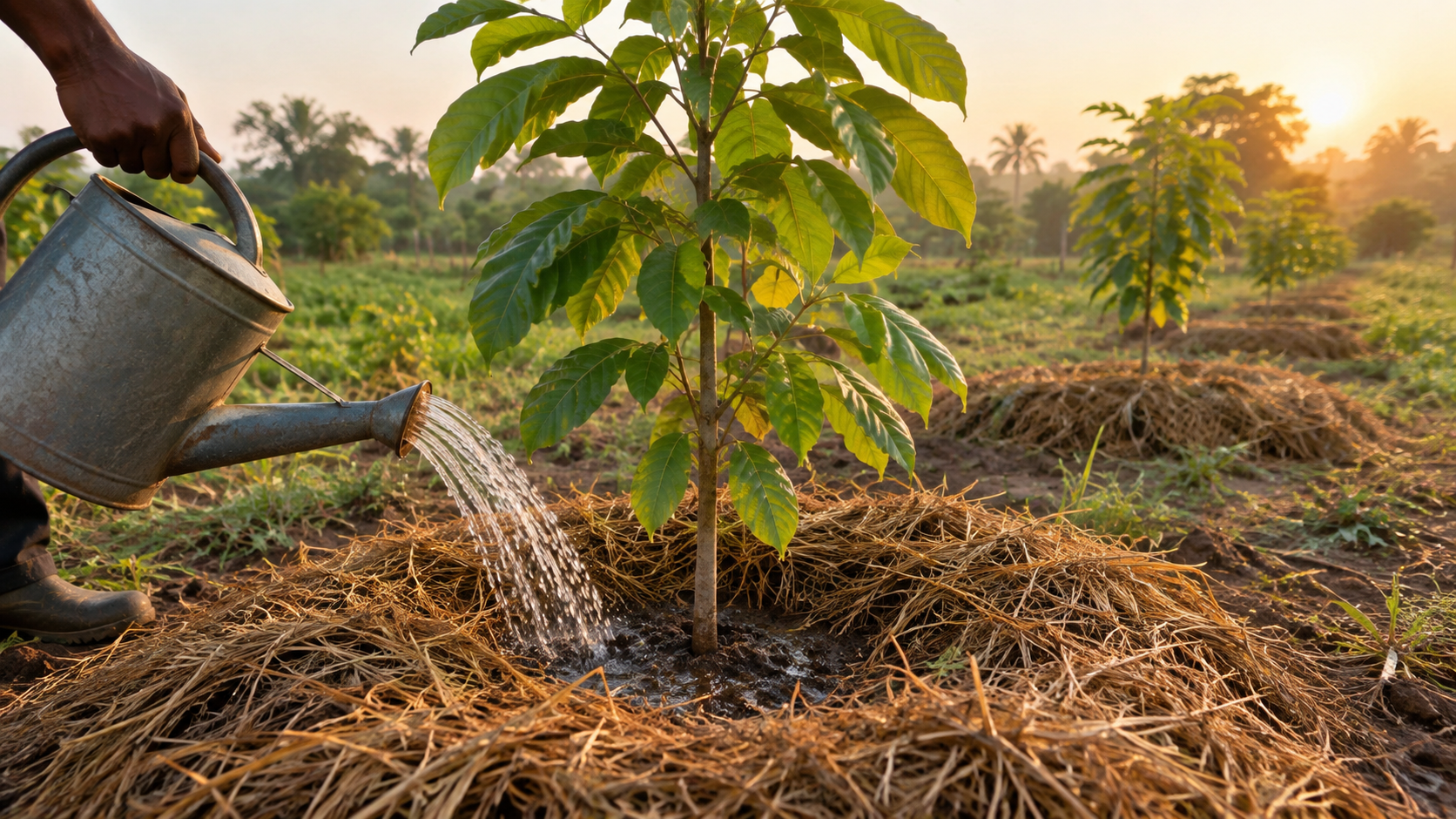
Most young trees that die in the dry season are not killed by drought. They are killed by the wrong watering habits. Here is what to do differently.
Ngozi planted 300 Gmelina seedlings on her farm in Enugu State at the end of the rainy season. They went into the ground healthy, well-rooted, and full of promise. By February, 80 of them were dead. The dry season had come hard and she had watered every day, sometimes twice, pouring water around the base of each tree in the middle of the afternoon when the sun was highest. She had worked harder than she needed to and lost more trees than she should have. The problem was not the water. It was when and how she gave it.
Young trees in their first and second dry season are the most vulnerable trees on any plantation. Their root systems have not yet gone deep enough to find water on their own, so they depend entirely on what the farmer provides. But more water is not always better. Watering at the wrong time of day wastes most of what is applied before the roots can use it. Watering too frequently keeps the surface wet while the deeper root zone stays dry. And overwatering on clay soils creates the same stress as underwatering because the roots cannot breathe.
REALITY CHECK
A young tree watered correctly twice a week survives a
dry season better than one watered incorrectly every day. The goal of dry
season watering is not to keep the soil surface wet. It is to push water deep
enough that the roots follow it downward. A tree with deep roots is a tree that
can look after itself. Getting it there is the job of the first two dry
seasons.
Water in the Morning or Evening, Never in the Afternoon
This is the single most important rule of dry season tree watering and the most widely ignored one. Water applied to the soil between 10am and 4pm in the Nigerian dry season evaporates from the surface faster than most root systems can absorb it. On sandy or loamy soils the loss can be 50 percent or more of what was applied. On dark soils that heat up quickly, even more is lost.
Water in the early morning before 8am or in the evening after 5pm. At these times the soil temperature is lower, evaporation is slower, and the water has time to move downward into the root zone rather than disappearing into the air. The same amount of water applied at the right time of day does two to three times more useful work for the tree than the same amount applied at the wrong time.
Water Deeply and Less Often Rather Than Lightly and Every Day
Light, frequent watering keeps the top few centimetres of soil moist while the deeper root zone stays dry. Young tree roots follow moisture. If moisture is always near the surface, the roots stay near the surface. A tree with shallow roots is completely exposed to any dry spell the moment the farmer cannot water for a few days.
Water deeply enough that the soil is moist 15 to 20 centimetres below the surface. Push a stick or your finger into the soil an hour after watering to check. If moisture has only reached five to eight centimetres, double the amount of water applied per session and reduce the frequency to every two to three days. The tree will develop deeper roots to follow the water and become progressively less dependent on daily attention.
Reduce Water Loss With Mulch Around Every Tree
A thick layer of dry grass, straw, or leaf litter spread around the base of each young tree, starting about five centimetres from the trunk and extending outward to cover at least 50 centimetres in every direction, reduces surface evaporation dramatically. On a hot dry season day, mulched soil stays measurably cooler and moister than bare soil in the same conditions. Farmers who mulch their young plantations consistently report needing significantly fewer watering sessions to maintain the same tree condition compared to unmulched plots.
The mulch also suppresses weeds that compete with young trees for the water you apply. It breaks down slowly over the dry season and adds organic matter to the soil around the roots. It is the cheapest and most effective water conservation tool available on any Nigerian farm and it requires nothing more than the dry material that is already lying around the farm at the start of every harmattan.
REALITY CHECK
By the end of the second dry season, a young Gmelina
or Teak tree with a well-developed deep root system needs very little
supplementary watering even through a long dry spell. Every correct watering
session in the first two seasons is an investment in a tree that will
eventually look after itself entirely. The effort front-loads so that the
plantation becomes progressively easier to manage over time, not harder.
Ngozi replanted the 80 trees she lost. This time she watered in the morning, applied twice the volume every three days instead of a little every day, and mulched around every base before the harmattan arrived. She lost four trees in the second dry season. Not eighty. Four.
The water was always available. The knowledge of how to use it was what changed everything.