
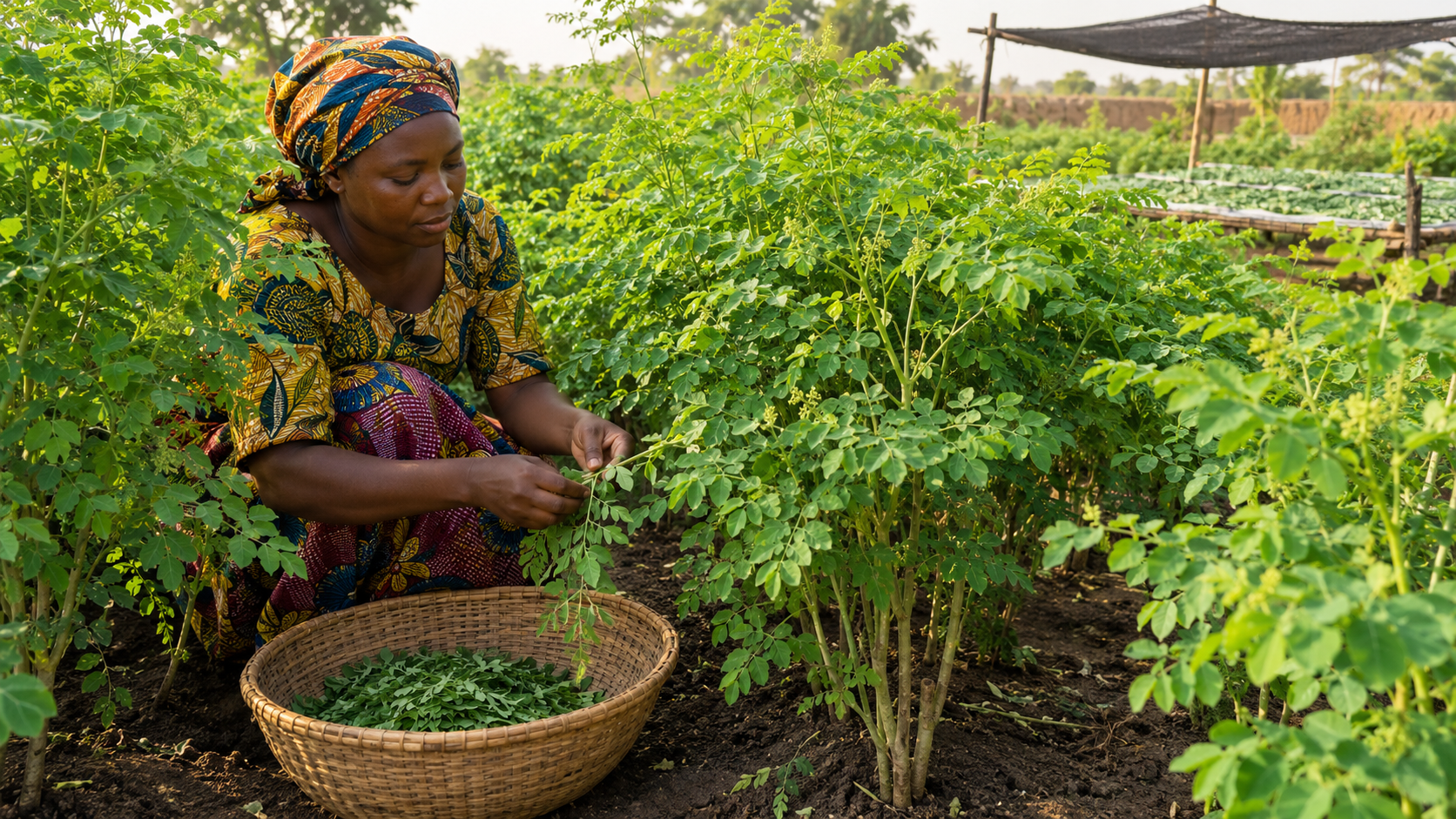
There is a tree growing along roadsides, fence lines, and forgotten corners of farms across Nigeria that sells for premium prices in health markets from Lagos to London. Most Nigerian farmers walk past it every day without knowing what it is worth.
Hauwa had three Moringa trees growing wild along the fence of her farm in Kano State. She had always known them as zogale, the plant her grandmother added to soups and weaning food for children. She did not know that the same leaves, dried and powdered, were selling online and in health shops across Nigeria for prices that would have seemed impossible for something growing untended on her land. When she found out, she did not uproot the fence trees. She planted 200 more.
Moringa oleifera, known locally as zogale in the north, ewe igbale in Yoruba, and okwe in parts of the south-east, is one of the most nutritionally dense plants on earth. Its leaves contain more protein per gram than eggs, more calcium than milk, and more iron than spinach. The global health and wellness industry has turned that nutritional profile into a multi-billion dollar market for Moringa powder, capsules, tea, and oil. Nigeria grows Moringa in abundance and exports almost none of it. The gap between what is growing on Nigerian farms and what global and domestic markets are paying for it is one of the most significant untapped agricultural opportunities in the country right now.
Reality Check
A kilogram of dried
Moringa leaf powder sells for between 8,000 and 15,000 naira in Nigerian health
markets depending on quality and packaging. The same kilogram sells for the
equivalent of 30,000 to 60,000 naira in European and North American export markets.
One hectare of well-managed Moringa can produce between 8 and 15 tonnes of
fresh leaves per year across multiple harvests. The drying ratio is roughly 5
kilograms of fresh leaves to 1 kilogram of powder.
How to Establish a Moringa Plot
Moringa is one of the easiest trees to establish on a Nigerian farm. It grows in almost any soil type including poor sandy soils where most crops struggle, tolerates drought better than most food plants, and begins producing harvestable leaves within three to four months of planting from seed. It does not need irrigation once established and requires minimal fertiliser input compared to conventional food crops.
Plant seeds directly into the ground at a spacing of one metre by one metre for intensive leaf production. This tight spacing encourages bushy, multi-stemmed growth that is easier to harvest and produces more leaf volume per hectare than widely spaced trees. Plant at the start of the rainy season for the easiest establishment. Water lightly every two to three days for the first three weeks until the seedlings are 20 to 30 centimetres tall and showing strong growth. After that, the plants largely manage themselves through the growing season.
How to Harvest and Process the Leaves
Begin harvesting when the plants reach 60 to 90 centimetres in height, typically six to eight weeks after germination. Cut the top third of each stem. This encourages branching and increases the number of harvestable stems for subsequent harvests. With proper management a Moringa plot can be harvested every six to eight weeks through the growing season, producing four to six harvests per year.
For fresh leaf sales to local markets, harvest in the morning and sell the same day. For dried powder production, spread the harvested leaves on a clean raised surface in a shaded, well-ventilated area. Direct sunlight destroys a significant portion of the nutritional content and reduces the market value of the final product. Dry in the shade until the leaves crumble easily between the fingers, typically three to five days in harmattan conditions and five to seven days in more humid conditions. Strip the dried leaves from the stems and grind or pound into powder. Store in airtight containers away from moisture and light.
Where to Sell and Who Is Buying
The domestic market for Moringa is growing faster than most Nigerian farmers realise. Health food shops, wellness centres, pharmacies stocking natural supplements, baby food producers, and hospital nutrition programmes are all active buyers of quality dried Moringa leaf and powder. Online platforms and social media have created direct sales channels that allow farmers to reach health-conscious urban consumers without going through a middleman.
For larger volumes, export aggregators and processors are actively looking for reliable Moringa suppliers with consistent quality. The key requirement for export markets is clean, shade-dried leaf with no contamination, proper moisture content below 10 percent, and ideally some form of basic quality documentation. A farmer who can supply consistent, clean, well-dried product at reliable volumes has a direct route into this market.
Reality Check
Moringa does not require a large plot to generate
meaningful income. A quarter hectare of well-managed Moringa producing four
harvests per year, dried and sold as powder at domestic market prices,
generates income every two months from land that might otherwise be sitting
unused between main crop seasons. It is not a replacement for the main farm
enterprise. It is what earns while the main crop is still growing.
Hauwa's 200 trees are now two years old. She harvests every eight weeks, dries the leaves under shade in her compound, and sells powder to three regular buyers in Kano and one online customer in Lagos who reorders every month without fail. The fence trees that started everything are still there. She has never once considered cutting them down.
The income was always on the farm. It just needed someone to recognise it.