
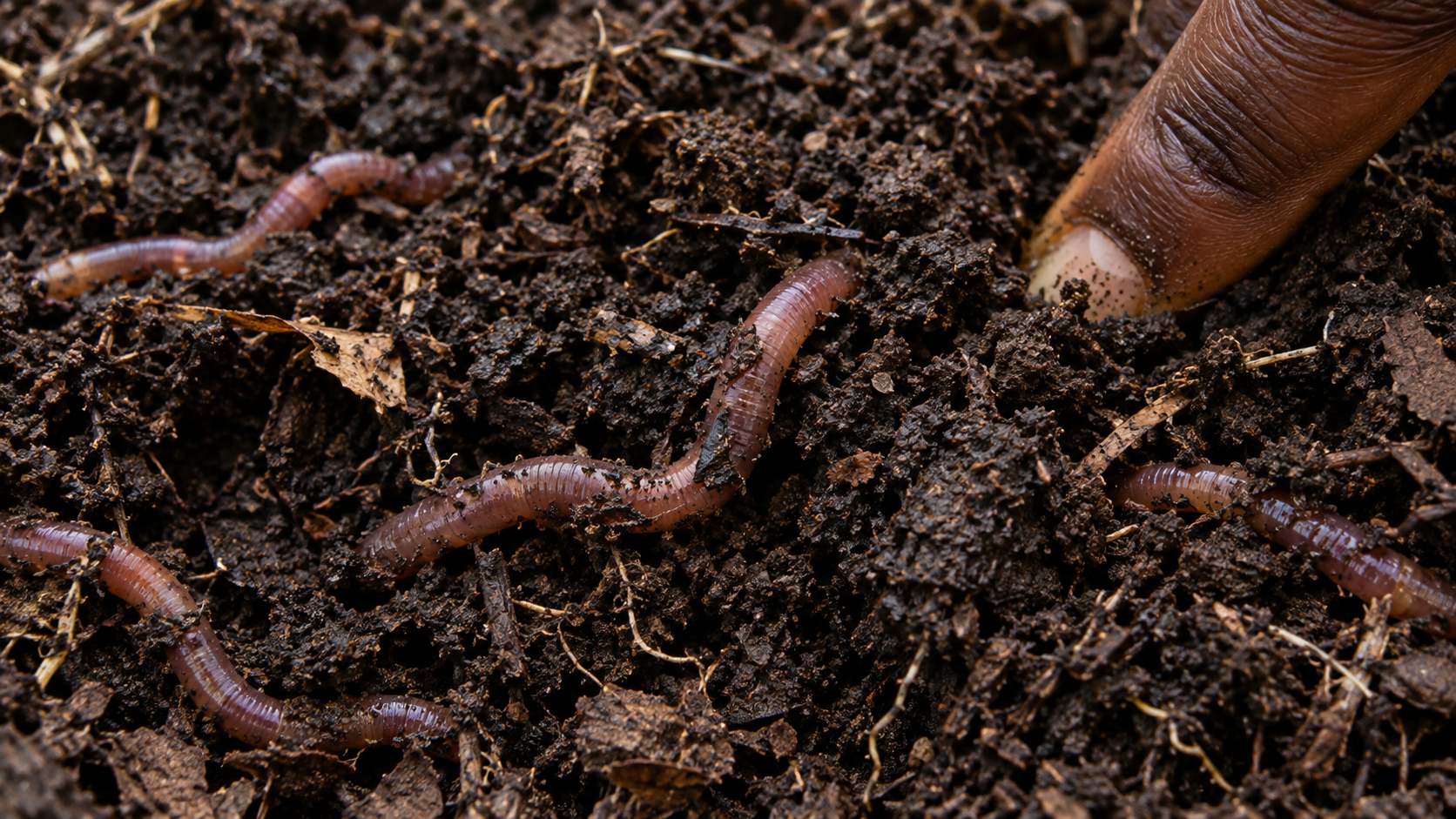
There is a worker on your farm that shows up every day, asks for nothing, and does more useful work than most inputs you are paying for. It lives underground. Most farmers are killing it without knowing.
If you dug a hole one metre square and one spade deep on a healthy Nigerian farm and counted everything you found, you would likely uncover between 50 and 150 earthworms depending on the soil condition. On a degraded farm that has been over-tilled and heavily fertilised for several seasons, you might find three. Or none.
Most farmers notice this difference and think nothing of it. An earthworm is just a worm. It has no obvious connection to yield, to soil fertility, or to the fertiliser bill. But that connection is real, it is significant, and it has been playing out quietly beneath every Nigerian farm since long before the first bag of synthetic fertiliser arrived on the continent.
Reality Check
A single earthworm processes between 10 and 30 times its own body weight in organic matter every day, converting it into a form that plant roots can absorb directly. A healthy population of earthworms in one hectare of farmland can turn over more than 50 tonnes of soil per year, improving its structure, drainage, and fertility as they go. No machine does this. No fertiliser does this. The earthworm does it for free.
What the Earthworm Actually Does
The earthworm does four things for your soil that matter directly to what you grow above it.
First, it aerates. As an earthworm moves through the soil it creates small tunnels that allow air and water to penetrate deeply rather than sitting on the surface or running off. On compacted soil with no earthworm activity, water pools and evaporates. On soil with a healthy worm population, the same rainfall soaks in quickly and reaches the root zone where crops need it.
Second, it improves drainage. Those same tunnels that let water in also let excess water drain downward rather than waterlogging the root zone. An earthworm-rich soil drains well in heavy rain and retains moisture in dry spells. Both at the same time. That is not something you can buy in a bag.
Third, it breaks down organic matter. Dead leaves, crop residues, and any organic material in the soil pass through the earthworm's digestive system and come out the other end as worm castings, one of the most nutrient-dense natural fertilisers available. Worm castings contain available nitrogen, phosphorus, potassium, and a range of trace elements that plants absorb immediately. Every casting deposited in your soil is a small, free fertiliser application.
Fourth, it feeds the wider soil biology. Earthworm activity creates the conditions that soil bacteria, fungi, and other beneficial microbes need to thrive. A soil with healthy earthworm populations has a more active and diverse biological community, which means better nutrient cycling, better disease suppression, and better crop growth overall.
What Is Killing It on Most Nigerian Farms
Three things kill earthworm populations on Nigerian farms faster than anything else.
Deep tilling is the most damaging. Every time a tractor or hand tool turns the soil deeply, it physically destroys earthworms, collapses their tunnel networks, and exposes the soil to conditions the worm population takes months to recolonise. Farms that are tilled deeply every season before planting consistently show lower earthworm counts than farms using reduced or no-till practices.
Heavy synthetic fertiliser use, particularly urea and other nitrogen compounds applied at high rates, creates soil chemistry conditions that earthworms find hostile. They move away from heavily fertilised zones or die. The fertiliser improves short-term crop nutrition but removes the biological system that would have improved it for free over the long term.
Leaving soil bare between seasons removes the organic matter and moisture that earthworms need to survive and feed. A bare, baked soil through the harmattan is a soil the earthworm population abandons. Cover cropping through the dry season keeps the conditions that support earthworm activity going year round.
Reality Check
The earthworm count test we described in an earlier article, digging a 30 centimetre square hole to spade depth and counting what you find, is the simplest and most reliable indicator of overall soil health available to any Nigerian farmer. Fewer than ten earthworms in that sample means the biological system that supports your crops is significantly depleted. More than thirty means your soil is in good biological health. The test costs nothing and takes five minutes.
How to Bring the Earthworm Back
Earthworm populations recover faster than most farmers expect once the conditions that depleted them are removed. Three practices make the biggest difference.
Reduce tillage. Switch from deep tilling to shallow surface preparation where possible. On plots where full no-till is not practical, reduce the depth and frequency of tillage and give the worm population time to reestablish between disturbances.
Add organic matter. Compost, mulch, and crop residues left on or dug lightly into the soil surface give earthworms the food and habitat they need to multiply. A farm that adds organic matter regularly will see earthworm counts increase within two to three seasons.
Keep the soil covered. A cover crop through the dry season maintains the moisture and temperature conditions that earthworms need to stay active rather than going dormant or dying. The cover crop feeds the earthworms. The earthworms improve the soil for the next main crop. The cycle looks after itself once it starts.
The earthworm has no contract, no salary, and no complaints. It has been working on Nigerian farms since long before farming had a name. It does not need recognition. It needs three things: less disturbance, more organic matter, and something to keep the soil covered.
Give it those three things and it will do the rest. For free. As it always has.