
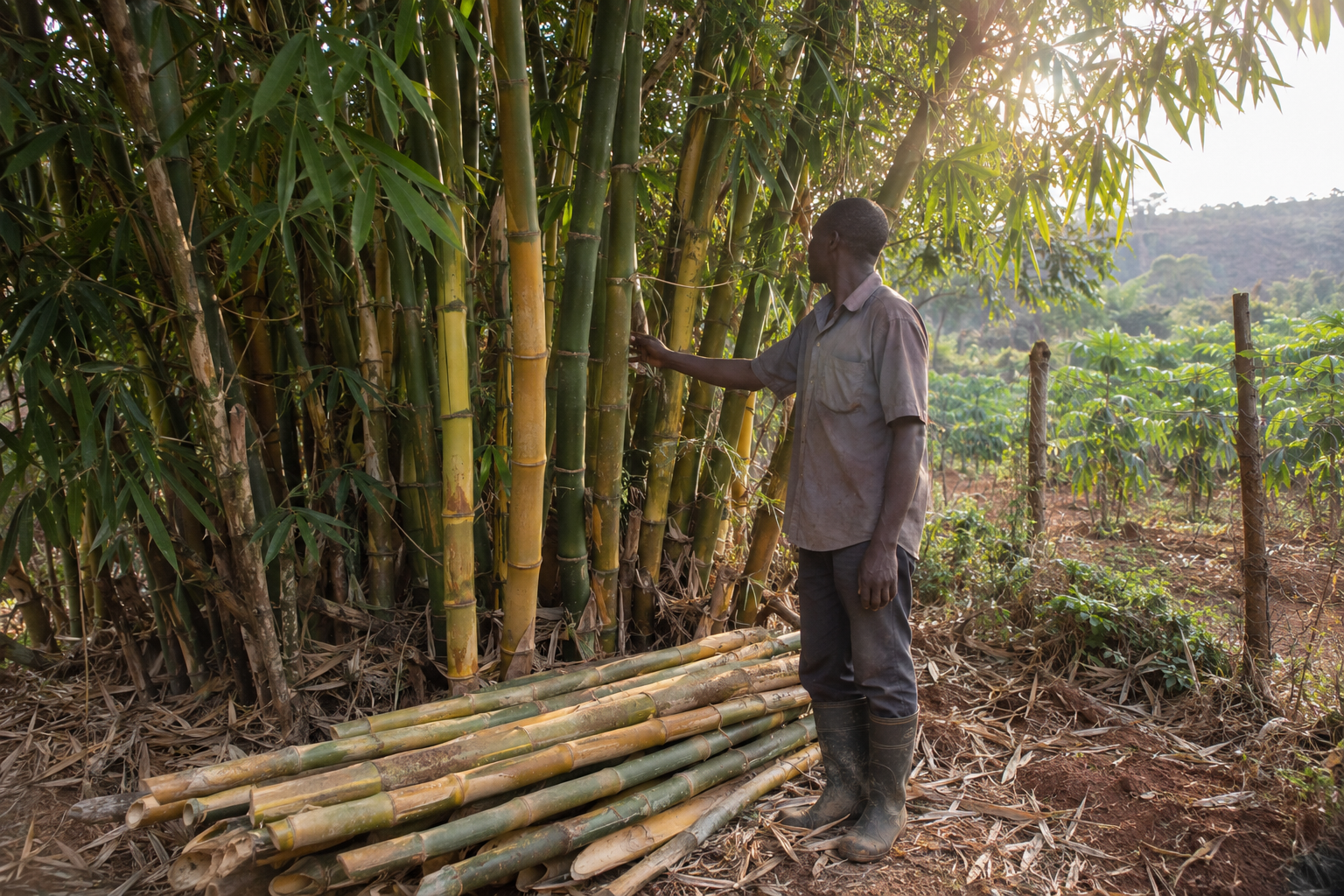
Bamboo is the fastest growing plant a Nigerian farmer can put in the ground. It matures in three to five years, earns from multiple income streams, and improves the land it grows on. Most farmers have never considered it.
Biodun had a narrow strip of land along the back fence of his farm in Ogun State that had never produced anything useful. The soil was shallow, the slope was awkward, and every time he planted something there it either washed away in the rains or dried out in the harmattan. He considered it wasted land. His neighbour suggested bamboo. Three years later that strip is producing construction poles he sells to builders in the next town, the slope is holding firm against erosion, and the soil underneath is measurably better than when he started. He is planning to expand the bamboo to a second strip next planting season.
Bamboo is not a tree in the technical sense. It is a grass, but it is the most productive grass on earth. Some species grow by as much as 30 centimetres in a single day under good conditions. It reaches harvestable maturity faster than any timber species in this series, spreads naturally to fill available ground once established, and offers multiple income streams simultaneously from the same planting. For Nigerian farmers looking to generate returns from marginal land, difficult slopes, or unused strips and boundaries, bamboo is one of the most underused opportunities available.
Reality Check
Unlike timber trees that produce one harvest at the end of a long rotation, bamboo is a continuous harvest crop. Once a bamboo grove is established, individual culms, which is the name for bamboo stems, can be selectively harvested every year from year three or four onward without uprooting or replanting the grove. The grove keeps producing indefinitely as long as it is managed correctly. It is one of the few crops that gets more productive, not less, as it matures.
Which Species to Plant in Nigeria
Not all bamboo is the same. There are two broad types: running bamboo, which spreads aggressively through underground stems and can be difficult to contain, and clumping bamboo, which stays in a defined area and expands slowly outward from a central point. For Nigerian farm conditions, clumping bamboo species are almost always the better choice. They are easier to manage, do not invade neighbouring plots, and produce the thick-walled, strong culms that construction and furniture markets prefer.
Bambusa vulgaris, known commonly as Common Bamboo, is the most widely available clumping species in Nigeria and the most versatile commercially. It grows well across a wide range of Nigerian soil types and rainfall conditions, produces large strong culms suitable for construction, furniture making, and charcoal production, and is the species most buyers in Nigerian markets already recognise and purchase. Dendrocalamus asper, sometimes called Giant Bamboo, is a larger species that commands premium prices for heavy construction use but requires more fertile soil and more consistent moisture to perform at its best.
How to Establish a Bamboo Grove
Bamboo is most reliably established from cuttings or divisions taken from an existing mature clump rather than from seed. A healthy division with at least two to three nodes and visible root material will establish far faster and more reliably than a seedling. Source divisions from a reputable nursery or from an established bamboo grove in your area.
Plant divisions at the start of the rainy season when soil moisture is consistent and establishment stress is lowest. For clumping species planted for commercial culm production, space each division five to eight metres apart to give the clump room to expand over its first three to four years without competing with its neighbours. Water regularly for the first six weeks until the division shows new growth, which is the signal that the root system has established. After that bamboo is largely self-sufficient, requiring no irrigation, minimal fertiliser, and very little management through the growing season.
What to Do With It When It Matures
From year three or four onward, a well-established bamboo clump produces harvestable culms every season. Harvest selectively, removing only the mature culms that have reached full diameter and wall thickness while leaving younger culms to continue growing. A healthy clump managed this way will produce harvestable material continuously for decades.
The income streams available from mature bamboo in Nigeria are broader than most farmers realise. Construction poles are the most established market, with consistent demand from builders across every Nigerian state. Furniture and craft producers in urban centres pay premium prices for straight, well-dried culms. Bamboo charcoal, produced by burning harvested culms in a low-oxygen environment, is a growing market serving households and food vendors who prefer it over wood charcoal for its longer burn time and lower smoke output. And the leaves, which drop continuously from the grove, make excellent mulch and composting material for the surrounding farm soil, adding organic matter at no cost through the same cycle we described in our leaf litter article.
Reality Check
Bamboo also holds soil together more effectively than almost any other plant. Its dense root system anchors slopes against erosion, reduces runoff during heavy rain, and gradually improves the soil structure beneath it through continuous organic matter addition. For Nigerian farmers with marginal land, slopes, riverbanks, or farm boundaries that are difficult to crop conventionally, bamboo is not just an income option. It is a land management solution that pays for itself.
Biodun's strip of difficult land is now the most productive boundary on his farm. It earns every dry season from pole sales, improves the soil on the slope below it, and requires almost no management once the rainy season planting is done.
The land was never wasted. It was just waiting for the right plant.