
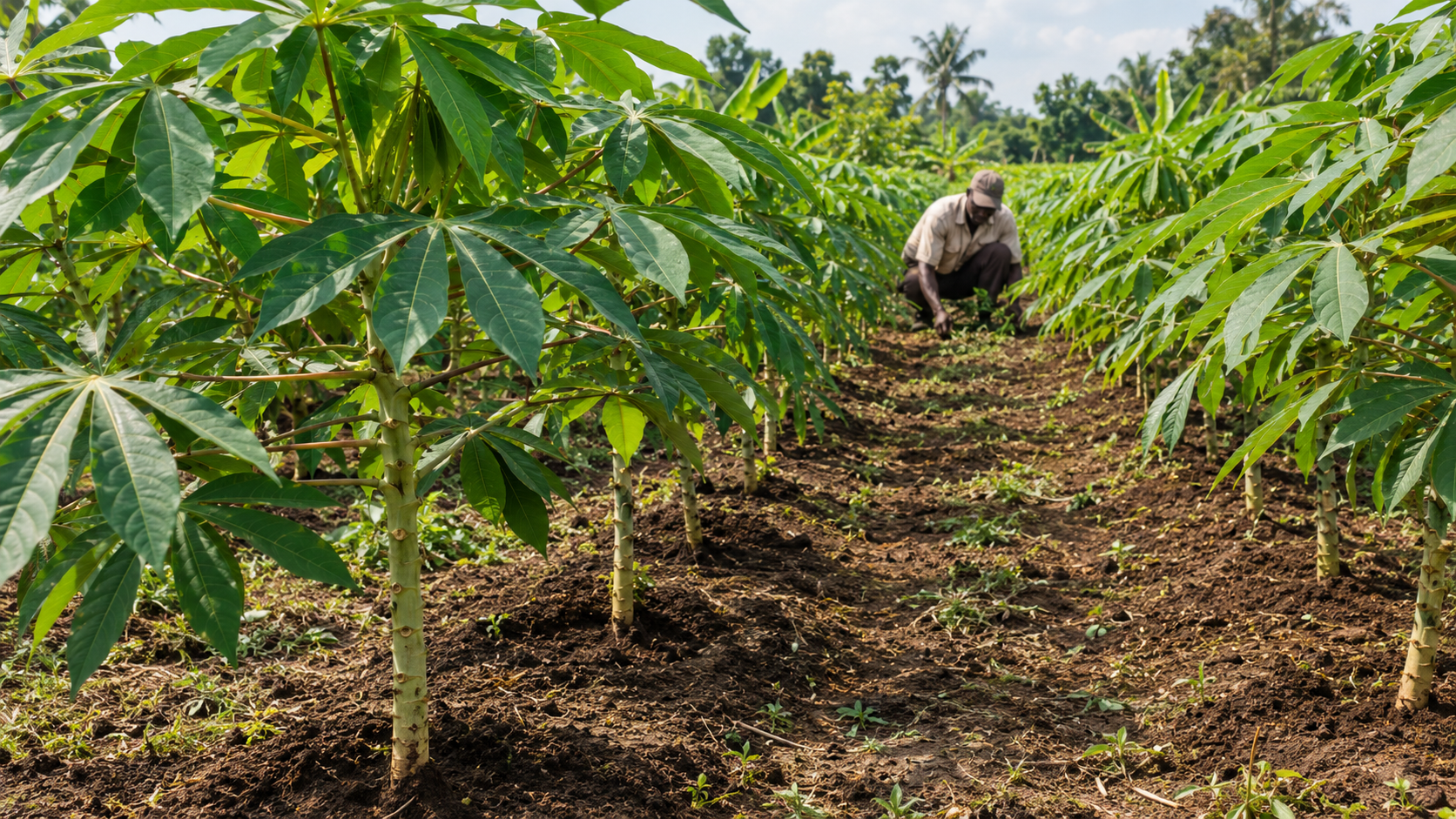
Nigeria is the world's largest cassava producer. The average Nigerian smallholder is getting a fraction of what their land can produce. The difference is almost always in four decisions made before and just after planting.
Amara grows cassava on two hectares in Anambra State the same way her family has always grown it. She plants stems cut from whatever is available, angles them however they go in, spaces them by eye, and harvests when the leaves start to yellow. Her yield is around eight tonnes per hectare. The national average for well-managed cassava in comparable conditions is between 20 and 25 tonnes per hectare. Amara is not a bad farmer. She is growing the right crop in the wrong way and nobody has told her what the right way looks like.
Cassava is the most forgiving crop in Nigeria. It grows in poor soils, survives drought, and produces something from almost any conditions. That forgiving nature is also why most farmers never optimise it. It grows regardless, so the assumption is that how you grow it does not matter very much. It matters enormously.
Reality Check
The yield gap between average Nigerian smallholder cassava production and well-managed plots on comparable land is not small. It is a difference of 10 to 15 tonnes per hectare. On a two-hectare farm, closing that gap represents a significant increase in income from the same land, the same labour, and the same growing season. The inputs required to close it cost less than most farmers spend on fertiliser for their current low-yield crop.
Start With the Right Stem and Plant It Correctly
The stem cutting is the seed of a cassava crop and most farmers treat it as an afterthought. Cuttings taken from old, diseased, or poorly performing plants carry those problems into the new planting. Before cutting anything, select stems only from healthy, vigorous plants that produced well in the previous season. The stem should be firm, not soft or shrivelled, between eight and twelve months old, and free of any visible disease or pest damage.
Cut the stem into sections of 25 to 30 centimetres, each with at least five visible nodes. Plant at an angle of 45 degrees with two thirds of the cutting below the soil surface. Vertical or flat planting reduces the surface area available for root development and consistently produces lower tuber yields than angled planting on comparable soil. This single change, planting at 45 degrees instead of vertically, improves yield on most Nigerian farms without any other intervention.
Get the Spacing Right
Cassava planted too closely competes for light, water, and nutrients, producing smaller tubers and lower total yield. Planted too widely, land is wasted and the canopy takes too long to close, allowing weeds to establish before the crop does.
The recommended spacing for maximum tuber yield in most Nigerian conditions is one metre between plants within the row and one metre between rows. This one by one metre spacing places approximately 10,000 plants per hectare, gives each plant enough space to develop a full root system, and closes the canopy quickly enough to suppress weeds naturally within eight to ten weeks of planting. Farmers who switch from wider or uneven spacing to a consistent one by one metre grid consistently report measurable yield improvements in the first season of change.
Control Weeds in the First Three Months
Cassava is most vulnerable to weed competition in the first three months after planting, before the canopy closes and shades the ground between plants. Weeds establishing during this window compete directly with the young cassava for the soil moisture and nutrients the developing root system needs. Studies across Nigerian growing conditions consistently show that uncontrolled weeds in the first three months reduce final tuber yield by 30 to 50 percent compared to weed-controlled plots.
Weed twice in the first three months, once at four weeks after planting and again at eight weeks. After the second weeding, if the spacing and planting were done correctly, the canopy will be closing and natural weed suppression will take over. No further weeding is normally necessary for the remainder of the growing cycle.
Harvest at the Right Time for Your Market
Cassava for the fresh food market is best harvested between nine and twelve months after planting, when starch content is high, texture is firm, and shelf life after harvest is at its longest. Left beyond twelve months, fresh market cassava deteriorates in quality and becomes increasingly fibrous.
Cassava destined for processing into garri, flour, or starch can be harvested later, between twelve and eighteen months, when tuber size and dry matter content are at their maximum. Processing cassava harvested at full maturity produces significantly higher output per tonne of fresh root than cassava harvested early. Knowing your market before you plant determines when you harvest, and knowing when you will harvest affects every management decision between planting and the end of the season.
Reality Check
Amara's eight tonnes per hectare is not a reflection of her land or her effort. It is a reflection of four decisions, stem selection, planting angle, spacing, and weed control, that were never made with yield in mind. Changing all four costs very little. The return on that change, measured in tonnes per hectare, is one of the best investments available on any Nigerian farm.
Amara's land is capable of producing 20 tonnes per hectare. The soil has not changed. The rain has not changed. The only thing standing between eight tonnes and twenty is the way the crop is managed from the first cutting to the last harvest.
Cassava does not need better land. It needs better decisions.